
A canal and river city with six historic districts
Tree Service in Huntington, IN
Riverbank trees, old neighborhoods and a flood-control lake upstream.
- Every estimate done in person around Fort Wayne and Allen County, Indiana
- The written quote lists what is and is not included
- Debris and stump handling decided in advance
The Wabash Runs Through It
Tree Service in Huntington follows the Wabash River, which cuts straight through the city. Huntington grew after the Wabash and Erie Canal was built through the county in 1834; by 1849 it had about 150 houses and 700 residents. Today it has 17,022 people as of the 2020 census and 7,768 housing units, and it sits within the Fort Wayne metro area. Its older blocks run up from the river, with mature trees planted along streets that date to the canal and railroad era.
Six historic districts
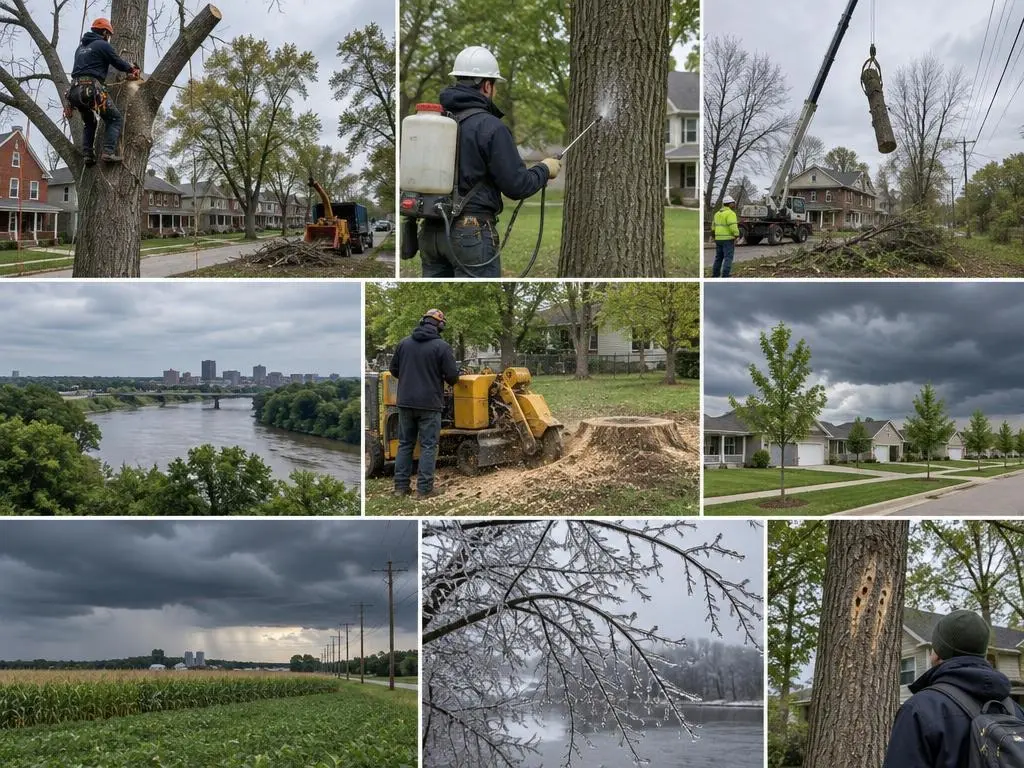
Huntington has six districts on the National Register: Drover Town, Hawley Heights, Courthouse Square, North Jefferson Street, Old Plat, and Victory Noll-St. Felix Friary. Homes in those neighborhoods often have tall shade trees right beside them, narrow side yards, and alleys with overhead service lines. Taking down a big tree in that setting means careful rigging; a climber cuts small sections and lowers each on a rope so nothing lands on the roof, the porch or the neighbor's garage.
Trees near the river
Along the Wabash and its low ground, sycamore, cottonwood, silver maple and box elder do well. They grow large fast, and when they fail, it's often a big limb dropping in summer or a root plate giving way in saturated soil. Upstream, the dam at J. Edward Roush Lake, completed in 1968 by the U.S. Army Corps of Engineers for flood control, regulates the river. Even so, lots near the water stay wet after heavy rain, and that is when shallow-rooted trees are most likely to tip.
Housing and who we work for
Census QuickFacts lists Huntington at 65.1% owner-occupied, with a median owner-occupied value of $119,500. With a large share of renters, we do a lot of work for landlords as well as owners. In both cases, the conversation tends to center on cost and priorities: which tree has to go now, which can wait, and how the work can be phased. We price each tree on the estimate so you can choose.
Common Huntington jobs
- Taking down dead ash and declining maples on older lots
- Pruning limbs away from roofs, chimneys and service drops
- Removing trees that have heaved sidewalks or crowded foundations
- Cleaning up after summer storms, especially near the river
- Grinding stumps so new trees or lawn can go in
Before the work
If a tree is near a utility line, the utility's crews handle the lines on the poles. Limbs on the service line to your house can be dealt with once the utility disconnects it. For trees near the street, we confirm whether they belong to the city before quoting any work on them.
Huntington University's arboretum
The Huntington University Arboretum and Botanical Garden is a good place to see how different species mature in local soil and climate before you choose a replacement tree. When we remove a tree, we are often asked what to plant instead. Our usual advice is to pick a species that fits the space at full size, keep large trees well away from overhead lines, and call Indiana 811 before digging the planting hole.
Call us
Call (260) 305-9252 or send photos with the form. We set a visit, look at each tree with you, and put the price in writing. Get a free estimate
Huntington Notes
- River city. The Wabash River cuts through Huntington; the Wabash and Erie Canal came through the county in 1834, and by 1849 the town had about 150 houses.
- Flood control upstream. J. Edward Roush Lake's dam, 91 feet high and about 6,500 feet long at the crest, was completed in 1968 for flood control and recreation and is run by the Army Corps of Engineers.
- Historic districts. Huntington has six National Register historic districts: Drover Town, Hawley Heights, Courthouse Square, North Jefferson Street, Old Plat and Victory Noll-St. Felix Friary.
- Housing. Census QuickFacts shows a 65.1% owner-occupied rate and a $119,500 median owner-occupied home value (2020-2024); the 2020 census counted 7,768 housing units.
Huntington Questions
Why do so many big trees fall near the river?
Trees on wet floodplain soil tend to have shallow roots, and the species that thrive there, like cottonwood and silver maple, grow fast with weaker wood. Saturated ground plus wind is the usual cause.
Can you remove a tree in a tight historic-district yard?
Yes. We take it down in small pieces, lowering each one on a rope, and protect the house, porches and fences as we go.
Can I spread tree work over several months?
Yes. The estimate prices each tree separately, so you can approve the urgent work now and schedule the rest later.
What should I plant after a removal?
Choose a species that fits the space at full size and keep large trees away from overhead lines. Call Indiana 811 before you dig.
Free Estimates in Huntington, IN
Free estimates across Huntington, from the river to the north side.
Tree Service Near Huntington
- Tree Service in Fort Wayne, IN
- Tree Service in New Haven, IN
- Tree Service in Huntertown, IN
- Tree Service in Leo-Cedarville, IN
- Tree Service in Grabill, IN
- Tree Service in Woodburn, IN
- Tree Service in Monroeville, IN
- Tree Service in Harlan, IN
- Tree Service in Hoagland, IN
- Tree Service in Churubusco, IN
- Tree Service in Columbia City, IN
- Tree Service in Auburn, IN
- Tree Service in Garrett, IN
- Tree Service in Waterloo, IN
- Tree Service in Roanoke, IN
- Tree Service in Bluffton, IN
- Tree Service in Ossian, IN
- Tree Service in Decatur, IN
- Tree Service in Kendallville, IN
- Tree Service in Aboite Township, IN
- Tree Service in Avilla, IN
- Tree Service in Markle, IN