
Where glacial Lake Maumee's old shoreline meets the Maumee River
Tree Service in New Haven, IN
Heavy, wet ground changes how trees root and how they fall.
- Every estimate done in person around Fort Wayne and Allen County, Indiana
- The written quote lists what is and is not included
- Debris and stump handling decided in advance
Trees on the Edge of the Old Swamp
Tree Service in New Haven has to start with the ground. The city sits at the westernmost point of prehistoric glacial Lake Maumee, where the lake bed later became the Great Black Swamp. That swamp was drained in the 1800s with hand-dug ditches and clay tile and turned into some of the richest farmland in the region, but the clay underneath still holds water. On many New Haven lots, roots spread wide and shallow instead of deep, and that shapes everything from how we judge a lean to how we plan a removal.
What shallow roots mean for you
A tree on saturated clay can look solid in August and tip in March, after a week of rain and a strong west wind. When we walk a New Haven yard, we look at the root flare, the soil on the side away from any lean, and whether the lawn has heaved or cracked near the trunk. A tree that has started to lift its root plate is a removal candidate even if its crown is green. Trees that are healthy but heavy on one side are usually better served by reduction pruning, which takes weight off long limbs so wind has less to push on.
Housing and lots
New Haven had 6,669 housing units at the 2020 census, and Census figures show about three in four are owner-occupied, with a median owner-occupied value of $166,900. The town was platted in 1839, became a city in 1963 and now spreads across Adams, Jefferson and St. Joseph townships. That mix gives us older lots near the center with mature trees and newer subdivisions on the edges where the trees are still young. Young trees on new lots are the cheapest to fix: a structural pruning in the first ten years can prevent the co-dominant trunks that split later.
The species we see most
The original swamp forest here was ash, elm, cottonwood and sycamore on the low ground, with oak and hickory on the drier ridges. Those same species still show up in older yards and along drainage ways. Ash in particular has been hit hard by emerald ash borer across northeast Indiana. Cottonwoods and silver maples grow fast on wet ground and get big quickly, which is why we are often asked to reduce or remove them near houses and garages.
Jobs we quote in New Haven
- Removing ash and other trees that have died back and turned brittle
- Crown reduction on fast-growing cottonwood and silver maple over roofs
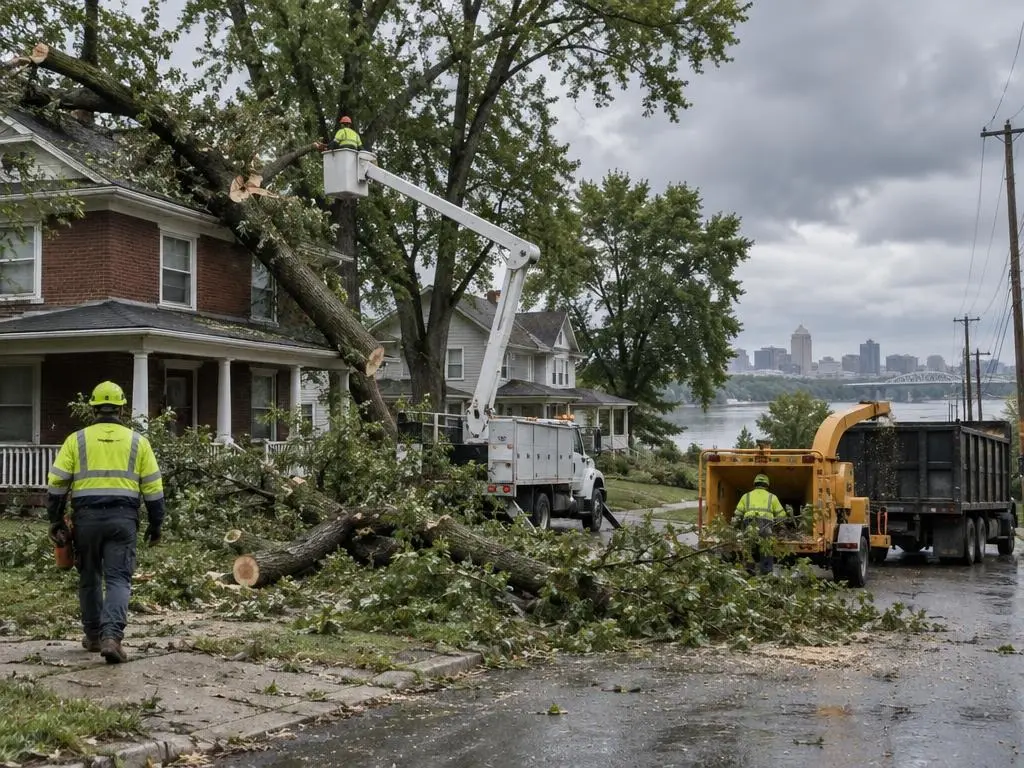
- Clearing limbs off houses, fences and driveways after storms
- Grinding stumps so the lawn can be leveled and reseeded
- Pruning young subdivision trees so they grow with one strong leader
Before work starts
If a tree is near the street, we check the Allen County GIS viewer for the right-of-way line and confirm who owns it. If limbs touch the line running to your house, the utility usually has to drop that service before anyone cuts. Stump grinding means a locate request through Indiana 811 at least two full working days ahead, which we handle. Then you get a written quote that lists each tree, the work, and whether we haul everything away. Get a free estimate
New Haven Ground and Housing
- Old lake bed. New Haven lies at the westernmost point of glacial Lake Maumee; the Great Black Swamp that formed on that lake bed began near New Haven and stretched east into Ohio.
- Clay that holds water. The swamp sat on water-retaining clay and till and was drained between 1859 and 1885 with ditches and clay tile, which is why many lots still drain slowly.
- Owner-occupied homes. Census QuickFacts lists a 75.7% owner-occupied rate and a $166,900 median owner-occupied home value for New Haven (2020-2024).
- Size of the city. The 2020 census counted 6,669 housing units in New Haven across parts of Adams, Jefferson and St. Joseph townships.
New Haven Questions
My yard stays soggy every spring. Does that put my trees at risk?
It can. Waterlogged clay loosens a tree's hold, and most trees that tip over here do it when the ground is saturated. If you notice soil lifting on one side of the trunk, call us before the next windy day.
Can you thin a big cottonwood instead of removing it?
Often, yes. Reducing the length of the heaviest limbs lowers wind load without stripping the tree. If the trunk or roots are already failing, though, pruning won't fix that, and we will tell you so.
Do you handle trees on the Fort Wayne side of the city line too?
Yes. We work in both cities, and we check which city's rules apply to the street trees on your block before quoting.
Free Estimates in New Haven, IN
Free written quotes for New Haven homes and lots.
Tree Service Near New Haven
- Tree Service in Fort Wayne, IN
- Tree Service in Huntertown, IN
- Tree Service in Leo-Cedarville, IN
- Tree Service in Grabill, IN
- Tree Service in Woodburn, IN
- Tree Service in Monroeville, IN
- Tree Service in Harlan, IN
- Tree Service in Hoagland, IN
- Tree Service in Churubusco, IN
- Tree Service in Columbia City, IN
- Tree Service in Auburn, IN
- Tree Service in Garrett, IN
- Tree Service in Waterloo, IN
- Tree Service in Huntington, IN
- Tree Service in Roanoke, IN
- Tree Service in Bluffton, IN
- Tree Service in Ossian, IN
- Tree Service in Decatur, IN
- Tree Service in Kendallville, IN
- Tree Service in Aboite Township, IN
- Tree Service in Avilla, IN
- Tree Service in Markle, IN