
Support for trees worth keeping
Cabling & Bracing in Fort Wayne, IN
Hardware in the crown that limits how far weak stems can move, so the tree is less likely to split.
- Every estimate done in person around Fort Wayne and Allen County, Indiana
- The written quote lists what is and is not included
- Debris and stump handling decided in advance
Holding a Good Tree Together
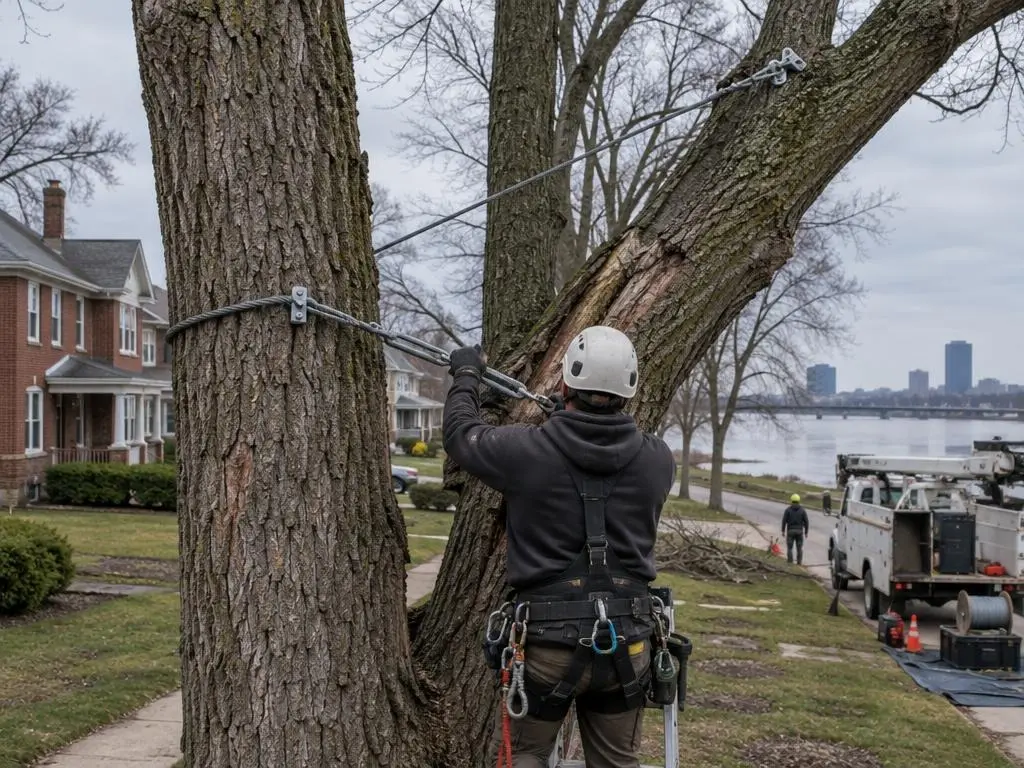
Cabling and bracing add support to a tree that has a structural weak point but is otherwise worth keeping. A cable is installed high in the crown between two stems or limbs to limit how far they can spread apart in wind; a brace rod is bolted through a split or weak fork lower down to keep it from opening. In Fort Wayne the classic candidate is a big silver maple with two or three trunks joined at a tight V, the kind of tree that splits in a summer storm or under ice.
Why tight forks fail
When two stems grow up side by side, bark can get trapped between them as they thicken. That included bark keeps wood from joining across the union, so the fork is weaker than it looks. Every windstorm works the stems back and forth. Silver maples, which the city's forestry plan names as the main tree in Fort Wayne's canopy, are prone to this, and so are Callery pears and some elms and lindens.
Industry standard work
The ANSI A300 standards include a section on supplemental support systems. Cables are usually set about two-thirds of the way from the fork to the tops of the stems, anchored with through-bolts or eye lags into sound wood, and sized for the stems they hold. Cabling works best combined with pruning that reduces the weight at the ends of the limbs, so the hardware carries less load.
When cabling is not the answer
Hardware cannot save a tree with serious decay at the base, a trunk that is already split open widely, or a root system damaged by construction or storm heave. If cabling would only delay a failure over the house, we say so and price removal instead. Cabling is also not a reason to skip inspection: it reduces risk, it does not remove it.
Upkeep
Cables and rods are not a one-time fix. Hardware should be checked every few years and after severe storms for wear, loosening and how the tree has grown around it. As the tree grows, a cable may need to be adjusted or replaced.
Trees in the right of way
Support systems on a city street tree are the city's call; Fort Wayne requires permission from its forestry office for any work on trees in the right of way. On your own lot, cabling is a way to keep a mature shade tree that would take decades to replace.
Support Options
What we install depends on where the weakness is.
Steel cable systems
Cables high in the crown to limit how far codominant stems move in wind.
Brace rods
Threaded rods through a weak or split fork to keep it from opening.
Weight reduction pruning
End-weight taken off long limbs so the support system carries less load.
Hardware inspection
Existing cables and rods checked for wear, slack and growth around the anchors.
Cabling Costs at a Glance
| Job | Published range |
|---|---|
| Tree cabling, average (HomeAdvisor) | $200 to $400 |
| Small tree cabling (HomeAdvisor) | about $175 |
| Medium or large tree cabling (HomeAdvisor) | $400 or more |
| General arborist inspection (HomeAdvisor) | $75 to $150 |
| Pruning, tree 30 to 60 ft (HomeGuide) | $600 to $1,200 |
Figures from HomeAdvisor's arborist cost guide (2026) and HomeGuide's tree trimming cost guide (2026). Multiple cables, brace rods and large crowns add cost; most cabling is paired with pruning. Your written estimate is the price.
How Cabling Works
1. Evaluate the fork
We look at the union, the stems and the base to see whether support will help.
2. Plan hardware and pruning
Cable or rod type, placement and any weight reduction, written on the quote.
3. Install
Hardware set into sound wood and tensioned to allow some natural movement.
4. Check over time
Hardware inspected every few years and after major storms.
Why Choose Us for Cabling & Bracing
Straight answers
If a tree is too far gone for cabling, we tell you before selling hardware.
Paired with pruning
We reduce limb weight so the support system lasts longer.
Cabling & Bracing Questions
How much does tree cabling cost?
HomeAdvisor's 2026 guide puts tree cabling at about $200 to $400 on average, around $175 for a small tree and $400 or more for medium and large trees. Brace rods, several cables and pruning add to that. We give a written price after seeing the tree.
Will a cable stop my tree from splitting?
It greatly lowers the chance by limiting how far the stems can move apart, but no hardware makes a tree failure-proof. Cabling works best on a tree that is otherwise sound, combined with pruning to reduce weight at the ends of limbs.
Does cabling hurt the tree?
The anchors make small wounds, which a healthy tree seals over. Installed to ANSI A300 standards in sound wood, the benefit of support usually outweighs that. Wrapping cables around a trunk, an older method, girdles the tree and should not be done.
How long do tree cables last?
Steel cables can last many years, but the tree keeps growing around them. Have the hardware checked every few years and after big storms, and adjusted or replaced as needed.
Is my silver maple a candidate for cabling?
Often, if it has two or three main stems joined at a tight fork and no serious decay at the base. If the fork already has a long open crack, or the trunk is hollow low down, removal may be the safer choice. We look at both before recommending either.
Cabling & Bracing Service Areas
- Tree Service in Fort Wayne, IN
- Tree Service in New Haven, IN
- Tree Service in Huntertown, IN
- Tree Service in Leo-Cedarville, IN
- Tree Service in Grabill, IN
- Tree Service in Woodburn, IN
- Tree Service in Monroeville, IN
- Tree Service in Harlan, IN
- Tree Service in Hoagland, IN
- Tree Service in Churubusco, IN
- Tree Service in Columbia City, IN
- Tree Service in Auburn, IN
- Tree Service in Garrett, IN
- Tree Service in Waterloo, IN
- Tree Service in Huntington, IN
- Tree Service in Roanoke, IN
- Tree Service in Bluffton, IN
- Tree Service in Ossian, IN
- Tree Service in Decatur, IN
- Tree Service in Kendallville, IN
- Tree Service in Aboite Township, IN
- Tree Service in Avilla, IN
- Tree Service in Markle, IN
Get a Cabling & Bracing Estimate
Support for weak forks in trees worth keeping.